
Menlo Park Previous Residents Source Map
Previous residents of a Menlo Park address leave different traces. Deeds show title, while reverse directories and census pages add household clues. Permits date work; probate and obituaries can explain transfers. Keep each role tied to a parcel, date, and source. Begin with San Mateo County ACRE and RecorderWorks, then move to the National Archives (NARA), libraries, the Menlo Park Historical Association (MPHA), or city files.
| Source | Years It Covers | Where Held | What It Shows |
|---|---|---|---|
| RecorderWorks name index | 1985-present | Online; ACRE counter | Named parties and metadata |
| Recorder computer index | 1963-present | Online/office; 1963-84 number/date | Document metadata |
| Microfilm/books | Pre-1963 | Recorder counter | Earlier parties/book-page |
| Regional directories | 1922; 1929-31; 1978-80 | NARA, San José California Room, MPHA | Occupants/addresses |
| Federal census | 1850-1950; 72-year release | NARA/library | Names, relationships, ages, enumeration districts |
| Accela/permits | 2019-present; Tidemark migration | Portal/Building Division/request | Work, participants, dates, documents |
| Probate/obituaries | Years vary | Court, MPHA, library, newspapers | Heirs, transfers, notices |
| Sanborn maps | Exact years unverified | Library, LOC, regional | Footprint/use/material changes |
Start with the newest source. RecorderWorks is free and requires no login, but it is an index, not an image vault. The counter and mail route matter for older deeds. For household names, the Menlo Park Library, MPHA's Merrill History Room, the NARA list, and the California Room supply the fallback shelf.
Menlo Park Address Records First
An address is a human label; the assessor's parcel number, or APN, is the stronger bridge into older records. The San Mateo County map search accepts address or APN, links to Assessor Map and recorded maps, and offers free downloads. Capture APN, map book/page, subdivision, lot or block, and legal description before searching a name.
The Menlo Park GIS Map Viewer exposes the physical address, jurisdiction, legal description, book/page/lot, record date, document number, last sale, year built, and district fields. Its inspected parcel layer omits owner and owner-mailing fields. A Menlo Park postal label also does not prove incorporated-city jurisdiction; West Menlo Park and Menlo Oaks can share the mailing name.
Menlo Park Previous Residents: Recorded Names
A deed chain is a sequence of transfers, not a resident list. Start with the parcel and the lawful ACRE assessment-roll channel, then search its named grantee in RecorderWorks. The purchase instrument supplies the grantor, legal description, recording date, and document number. Search the seller as grantee to move backward. The public parcel layer omits owner and owner-mailing fields, so a map click cannot replace the county record.
The RecorderWorks grantor-grantee index is the county's free starting screen for the name trail.
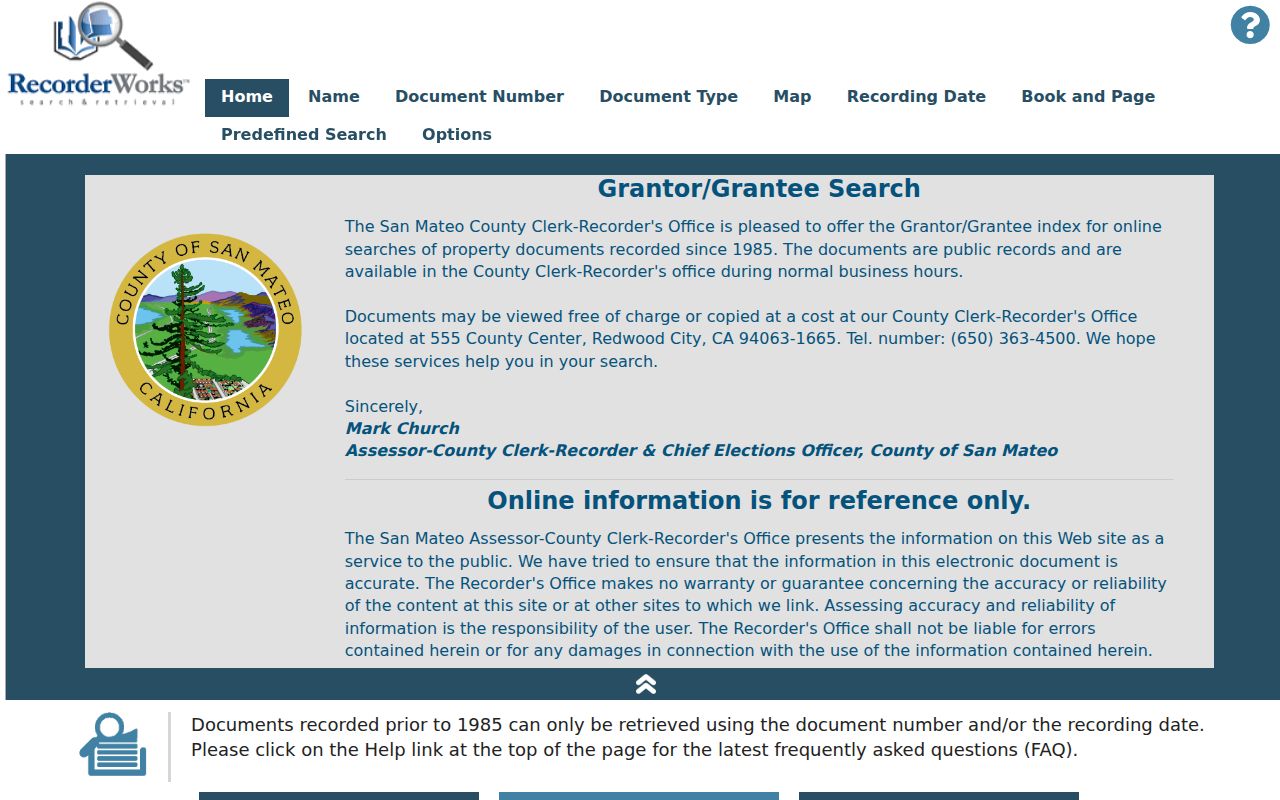
The capture shows the county index entry point. It contains no deed image and does not prove occupancy; read or order the instrument before relying on its legal description.
- Resolve the physical (situs) address to an APN, legal description, and lawful assessed-owner channel.
- Search the grantee with
LAST FIRST, a party-role choice, partial matching, and a purchase-date window. - Record the document type, date, number, legal description, APN, and legacy book/page.
- Read the deed, search its seller as grantee, and repeat. Test trust, company, initial, and punctuation variants.
- At the cutoff, carry the number/date or book/page to the counter, microfilm, or deed books.
- Grantor
- The party transferring an interest.
- Grantee
- The party receiving it, usually the buyer in a purchase deed.
- Chain of title
- Linked recorded transfers from one title holder to an earlier one.
- Legal description
- The deed or map identity of the land, often subdivision, lot, block, or metes-and-bounds data. It can outlast a street label.
RecorderWorks excludes images. A copy is $5 for the first page and $1 per extra page; certification adds $5 and a conformed label $10. Confirm fees. The Recorder phone is 650-363-4500. Mail instrument data, payment, and a stamped envelope to Customer Service Desk, San Mateo County Clerk-Recorder, 555 County Center, Redwood City. Use a U.S.-bank check, money order, or cashier's check payable to San Mateo County Clerk-Recorder.
Menlo Park Records Across Eras
Menlo Park deed research changes method as it moves backward: name-searchable documents since 1985; computer metadata from 1963, with 1963-84 retrieval needing a document number or date; and pre-1963 office microfilm. A missing online name result may mean the record is outside the web range, indexed under a trust or prior name, or reachable only by number or date.
[QUIRK] RecorderWorks is a ladder, not one continuous digital shelf. Move from the 1985 name index to 1963 metadata, then to microfilm and books at the Recorder counter. Do not treat an empty first search as proof that no transfer occurred.
Menlo Park Document Records Bridge
From 1980 forward, instrument numbers are the normal citation; before 1980, book and page remain the key reference. A 1963-84 search still needs document number and recording date. Preserve book/page, map, subdivision, lot/block, legal description, and APN together. RecorderWorks uses a year plus six-digit document sequence and accepts book/page and date on legacy searches.
If an old deed uses a different street number or spelling, search the land identity first. Keep its date, both address forms, and the document number or book/page in the note.
Menlo Park Directories for Previous Residents
Directories add the household layer. Verified runs include a 1922 regional volume, a 1929-31 Palo Alto run containing Menlo Park, and Menlo Park directories from 1978-80 at the San José Public Library California Room. R. L. Polk volumes appear in building research, but the exact run is unconfirmed. The MPHA archive holds local material and The Gate Post; the Internet Archive can surface digitized items.
Use the Menlo Park Library, 800 Alma Street, 650-330-2520, or its Belle Haven branch, 100 Terminal Avenue, 650-330-2540. The Merrill History Room is the in-person MPHA channel. NARA supplies the regional listing; contact the California Room to verify missing volumes.
- Start with a deed, census, obituary, school, or permit date.
- Search alphabetically, preserving initials and spelling.
- Record the address, spouse notation, household marks, and abbreviation key.
- Use a reverse or criss-cross section when present; not every volume has one.
- Move volume by volume. Mark first and last appearances; absence is not proof of death or departure.
The collection shelf belongs with the Menlo Park city directory research. Exact local reverse-directory years, obituary-index coverage, newspaper microfilm years, and church-register holdings were not published.
A Palo Alto Directory Story
[STORY] The NARA 1929-1931 listing places Menlo Park inside a Palo Alto run that also names North Palo Alto, East Palo Alto, Ravenswood, and Stanford University. Search title geography, not only “Menlo Park directory.”
During World War I, Camp Fremont briefly brought as many as 40,000 people to a town of fewer than 2,000. Military rosters, newspapers, and local business records may catch a short-lived household, but every name still needs a date and place.
Menlo Park Resident Census Pairing
The federal census supplies a household check that a deed cannot. Schedules from 1850 through 1950 follow a 72-year release schedule, making 1950 the latest fully released identifiable year here. Pair a 1929-31 directory with 1930, then use 1950 as the later checkpoint. Census pages show names, relationships, ages, and enumeration geography, not occupancy between schedules.
- Criss-cross directory
- An address-oriented or reverse section that lets a researcher read a street number and nearby entries instead of starting with a surname.
- Enumeration district
- The local area assigned to a census taker. It helps locate a household when a street name or city heading differs from the directory.
Pairing works best as a short process:
- Write down the directory year, number, names, initials, and unit or nearby-number clue.
- Find the 1930 or 1950 schedule through NARA or library genealogy access; note its enumeration district.
- Compare names, relationships, ages, and street context, allowing for spelling and boundary changes.
- Mark the match confirmed, possible, or unresolved. Keep the citation beside the directory entry.
Jurisdiction can shift while the land stays put. San Mateo County formed in 1856; Atherton incorporated in 1923, Menlo Park in 1927, and Belle Haven joined Menlo Park in 1961. A directory heading or custodian can change without a physical move.
Menlo Park Permit Records: Tidemark to Accela
Permit history dates work, not every person in a house. Menlo Park launched Accela in November 2019 after replacing Tidemark. Older material may be migrated, and historic files may predate the portal. Search Applications accepts record number/type, project, dates, street fields, unit, APN, first/last name, business name, and license number. Results can show work, participants, contacts, inspections, dates, and attachments, not a complete household.
The Accela portal permits public searching; registration is needed to create or submit. For missing older files, contact the Building Division or use the city's public-records channel with address/APN, record type, and date range. The California Public Records Act (CPRA) reaches existing records, not a staff-built resident list.
Menlo Park Previous Residents Address Bridge
When a number changes, Menlo Park's official bridge is an address-change file under Municipal Code Chapter 12.28. The Building Official reviews an owner-signed form and site plan emailed to the Permit Team; after a complete submission, the fee is $129. Police and the Menlo Park Fire Protection District receive the approval route. ADUs use the primary address with Unit A, B, or C, while new subdivision and other project addresses are reviewed during entitlement.
[INSIDER TIP] The file can connect old and new numbers across deeds, directories, and permits. Request it by parcel or address through the city address instructions, Building Division, or public-records channel. Keep APN and legal description beside both forms.
Lawful house history. Use a Menlo Park address trail for genealogy, estate or heir research, historic study, and personal curiosity. California law can treat stalking, threats, and harassment as unlawful; do not use names or addresses to follow, threaten, or harass a living person.
Menlo Park Probate Records and Obituaries
A final deed may name an heir or estate, but probate is a San Mateo Superior Court series, not a County Clerk registry. The court's online access shows nonsealed party, case, date, and docket data. Records Management is at 400 County Center, first floor Room A, Redwood City, Monday-Friday, 8:30 a.m.-1 p.m.; up to five files may be requested. Offsite retrieval is $10, generally 72 hours, held five working days. Mail needs case number, parties, date or document, SASE, and a blank check marked “Not to Exceed”; allow 30 days, and staff do not research.
Obituaries can point to heirs, but exact local index coverage was not verified. Check MPHA's Merrill History Room, the bound Almanac run from the 1970s-1980s, The Gate Post from 1975-present, and Menlo Park Library databases. Match a notice to deed, directory, census, or probate evidence; absence is an unresolved gap.
Menlo Park Resident Map Gaps
Sanborn fire-insurance maps can add footprint, use, construction, and material changes. The reviewed Menlo Park research did not verify exact local years or a complete holding. Check the Menlo Park Library, Library of Congress, and regional collections by street, parcel, edition, and title. Confirm the year before citing it.
Use a verified sheet beside the legal description, deed, directory, and permit. It can show a structure change, but cannot name every prior resident, prove title, or fill a missing year.